Skip to content
Surgical Release

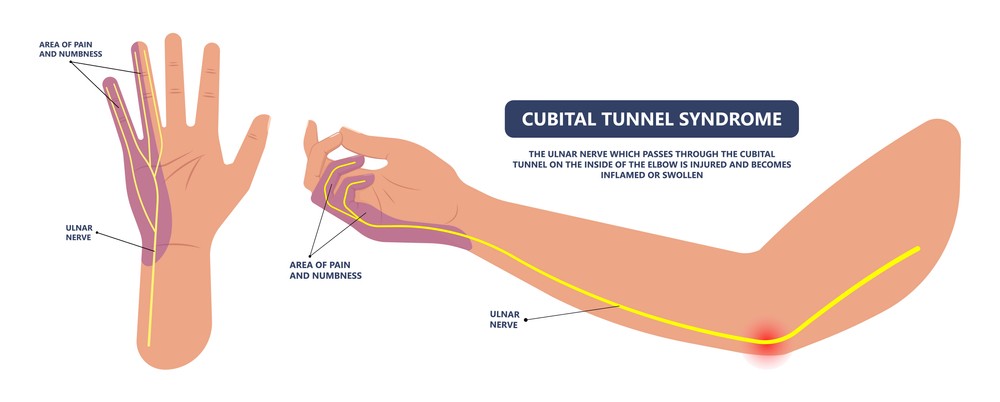
It is also known as ‘Ulnar Nerve entrapment release.‘ It is performed by placing an incision in the longitudinal direction over the cubital tunnel. This helps release the tension on the fibers connecting the elbow joint in place. The nerve is then located and then freed from the engaging structures and is sometimes placed anteriorly, subcutaneously, or in deeper structures; between the muscles (intramuscular location) or submuscular (on top of the muscles).
This transposition of the ulnar nerve resolves the compression and the symptoms that come with this syndrome. Despite this surgery is minimally invasive, there is always a risk of damaging the nerve fibers and that becoming a painful neuroma in later stages of life. The following are the complications that can exist after the surgical procedure:
- Infection.
- Pooling of blood at the site of incision (Hematoma formation).
- Reflex Sympathetic Dystrophy due to damage of the nerve fibers.
- Weakness despite the procedure.
- Decreased sensory sensation in the fingers due to damage to ulnar nerve fibers.
These postoperative complications can be minimized if the surgeon handling the case is experienced and is operating in a well-sanitized operating room.
References
- Cutts S. Cubital tunnel syndrome. Postgraduate medical journal. 2007 Jan 1;83(975):28-31.
- Chauhan M, Anand P, Das JM. Cubital Tunnel Syndrome. StatPearls [Internet]. 2020 Nov 2.
- Assmus H, Antoniadis G, Bischoff C. Carpal and cubital tunnel and other, rarer nerve compression syndromes. Deutsches Ärzteblatt International. 2015 Jan;112(1-2):14.
- Kooner S, Cinats D, Kwong C, Matthewson G, Dhaliwal G. Conservative treatment of cubital tunnel syndrome: a systematic review. Orthopedic reviews. 2019 May 23;11(2).
- Shah CM, Calfee RP, Gelberman RH, Goldfarb CA. Outcomes of rigid night splinting and activity modification in the treatment of cubital tunnel syndrome. The Journal of hand surgery. 2013 Jun 1;38(6):1125-30.
- Nakashian MN, Ireland D, Kane PM. Cubital tunnel syndrome: current concepts. Current Reviews in Musculoskeletal Medicine. 2020 Aug;13(4):520-4.