Skip to content

10 Symptoms of Lung Cancer
Lung cancer is a silent disease since it does not usually cause symptoms in the early stages. Generally, when the first signs appear, the disease is already advanced. In addition, on many occasions, the symptoms caused by lung tumors are very nonspecific and are mis associated with other diseases.
-
Unexplained Weight Loss
One of the most frequent symptoms in cancer patients is weight loss, in fact, 60% of patients with lung cancer present this symptom at the time of diagnosis.
On one hand, hypermetabolism increases basal energy expenditure, while on the other, factors like the tumor’s release of proinflammatory molecules (interleukin-1, interleukin-2, and TNF-alpha) suppress brain signals that trigger appetite, leading to significant loss of appetite.
2. Fatigue
Most patients with cancer suffer from fatigue, this symptom is often described as persistent physical, emotional and mental exhaustion. The fatigue-related to lung cancer is different from the feeling of tiredness because of not having enough rest since it interferes with daily life and is not related to the level of physical activity and does not improve with rest.
3. Cough
A cough is usually a valuable resource that helps eliminate germs or harmful elements from airways. However, sometimes, the cough is not linked to a cold or an infection and may persist for weeks or months as is often the case in patients with lung cancer.
A chronic cough is the most characteristic symptom of patients, and is caused by the irritation generated by the tumor in the bronchi and bronchioles. In those patients, usually, smokers who already had a cough as a result of respiratory problems, there is an increase or exacerbation of this symptom.
4. Bloody Sputum
It is one of the most alarming symptoms for the patient and is usually one of the main reasons for consultation. The bloody expectoration called Hemoptysis in medical slang is due to the progressive destruction of lung and bronchial tissue caused by the growth of the tumor.
5. Breathing Difficulty
As the disease and damage to the lungs progress patients with lung cancer begin to experience a sensation of shortness of breath that prevents them from performing activities of daily living such as climbing stairs or even dressing. This is a very disabling symptom that considerably diminishes the quality of life of people.
6. Chest Pain
Pain in the chest usually occurs when the lung tumor grows and invades the parietal pleura, the serous membrane that lines the lungs, or the chest wall. It is more common in tumors that affect the periphery of lung tissue.
The chest pain produced by lung cancer is usually sharp and its intensity increases as the tumor grows. The most characteristic is its relationship with respiratory movements: it is aggravated by deep breathing, coughing, and sneezing.
It also worsens with the movements of the trunk and is relieved by the immobilization of the affected side, this causes the patient to breathe superficially and to be placed in lateral decubitus to limit the movement of the thorax.
7. Dysphonia

Occasionally patients with lung cancer experience hoarseness or changes in the tone of voice product of the invasion of the tumor into the mediastinum where it involves the recurrent laryngeal nerve responsible for the movement of the vocal folds.
8. Shoulder Pain
Many people take this symptom as irrelevant, but the chronic pain in the shoulders can be the result of a tumor pressing the brachial plexus (set of nerves located at the base of the neck and armpit), resulting in tingling sensations and shooting pains from the shoulder to the arms.
This symptom is characteristic of tumors located in the pulmonary apex. In some cases the shoulder pain is presented in conjunction with palpebral ptosis, absence of sweating of half of the face and miosis, forming the so-called Pancoast syndrome.
9. Recurrent Infections

Cancer patients have a severely compromised immune system that predisposes them to develop infections. Patients with lung cancer usually present bronchitis or pneumonia recurrently and in many cases, the treatment of these infections is cumbersome due to the alteration of the defense mechanisms of the organism.
Lung Cancer Diagnosis

The tests used to diagnose lung cancer have two purposes. First, they help the oncologist determine the exact type of tumor you have. On the other hand, they allow determining what phase it is. An accurate diagnosis allows for determining which will be the most appropriate treatment.
The following are the most commonly used techniques to diagnose lung cancer:
Imaging tests: Imaging tests are used to determine the size, shape, and location of the tumor. They are also used to determine if there is a distant metastasis in some other organ or lymph node of the body
- Chest x-ray
- Computed axial tomography
- Positron emission tomography
- Magnetic resonance
Procedures for staging and obtaining samples: Staging procedures are the diagnostic methods that allow the specialist to see directly the lung and nearby areas and, in addition, obtain samples of lymph nodes or other tissues to be able to analyze them later (biopsy and/or cytology).
- Bronchoscopy
- Mediastinoscopy
- Biopsy with endobronchial ultrasound
- Thoracoscopy
- Thoracocentesis
Analysis of tissue samples: Tissue samples obtained through the procedures described above are analyzed by a pathologist to determine if cancer cells exist. We must remember that the definitive diagnosis of cancer is provided by the histological study of the tissue obtained by biopsy or cytology.
Lung Cancer Treatment

The treatment of lung cancer depends on several factors:
- The stage in which the disease is found.
- The type of tumor (Small cell lung carcinoma, Non-small cell lung carcinoma, Squamous cell carcinoma, Non-squamous carcinoma)
- The individual characteristics of each patient, such as their age, other pathologies (especially associated with smoking, heart disease, respiratory problems), nutritional status, etc.
For the treatment of lung cancer, there are four therapeutic measures: surgery, radiotherapy, chemotherapy, and targeted therapy (against a molecular target of the tumor). Surgery and radiotherapy are considered local therapies, while chemotherapy and targeted therapy are considered systemic since drugs are distributed throughout the body through the bloodstream. Generally, the treatment of lung cancer requires a combination of several of these therapeutic measures.
Types of Lung Cancer
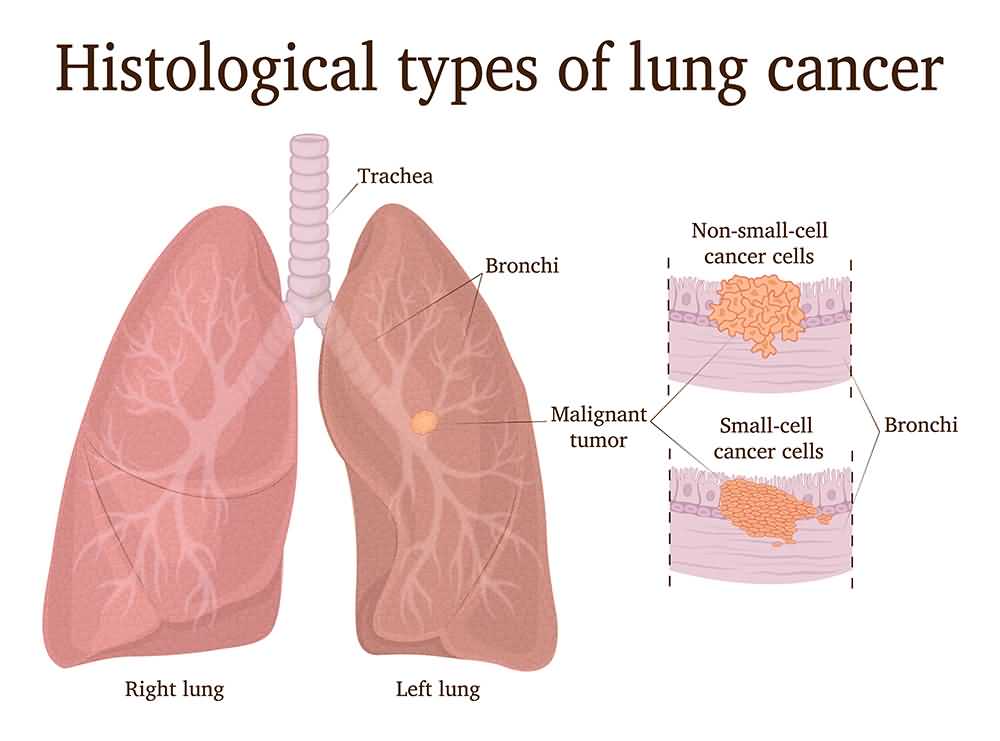
Lung cancer is classified based on the type of cell that causes the tumor. In order to determine this nature, it is necessary to carry out a histological diagnosis, which consists of the study of a portion of tissue under a microscope.
There are mainly two different types of lung cancer:
- Small cell lung carcinoma: represents approximately 20% of lung tumors that are diagnosed and are closely related to smoking. It is usually very aggressive and spreads rapidly to other parts of the body. It tends to present a better response to chemotherapy than other types of lung cancer.
- Non-small cell lung carcinoma: It represents approximately 80 percent of diagnosed lung tumors. It is subdivided into three types:
» squamous cell carcinoma: Represents 40% of lung cancers, being the most common type. They are centrally located and their growth is relatively slow causing necrosis (irreversible tissue death) and cavitation (pathological formation of cavities in tissues or organs).
» non-squamous carcinomas:
– Adenocarcinoma: It represents 30% of cases of lung cancer and is the most frequent in women. This tumor is located in the periphery of the pulmonary tissue and can affect the pleura and the chest wall.
– Large cell carcinoma: Represents 10% of lung tumors. It has characteristics other than squamous cell carcinoma and adenocarcinoma.
Causes and Risk Factors
Smoking is the fundamental cause of lung cancer, whether in cigarettes, pipes or cigars. Between 80% and 90% of lung cancer occurs in smokers or former smokers, although there is also a risk in passive smokers. The abandonment of smoking is very important in these patients since it directly affects survival as well as the effectiveness and tolerance of the treatments.
There are factors that increase the risk of developing this type of tumor, such as advanced age and male sex. This last parameter probably related to the highest consumption of tobacco in this group. However, in the last few years, the incidence of lung cancer in women has increased, this can be attributed to the increase in smoking among women. Additional causes;
- Exposure to certain substances such as asbestos or radon.
- Environmental pollution in urban areas.
- Family history of lung cancer.
Medical Disclaimer: The information provided in this article is for educational and informational purposes only and is not intended as medical advice, diagnosis, or treatment. Always seek the guidance of a qualified healthcare professional or your physician with any questions you may have regarding a medical condition or health concern. Never disregard professional medical advice or delay seeking it because of something you have read on A2ZHealthy.com. Reliance on any information provided on this site is solely at your own risk
References
Alberg AJ, Samet JM. Epidemiology of lung cancer. Chest 2003; 123: 21S-49S.
Beckles MA, Spiro SG, Colice GL, Rudd RM. Initial evaluation of the patient with lung cancer: symptoms, signs, laboratory tests, and paraneoplastic syndromes. Chest 2003; 123: 97S-104S.
Schreiber G, McCrory DC. Performance characteristics of different modalities for diagnosis of suspected lung cancer: summary of published evidence. Chest 2003; 123: 115S-128S.
Silvestri GA, Tanoue LT, Margolis ML, Barker J, Detterbeck F; American College of Chest Physicians. The noninvasive staging of non-small cell lung cancer: the guidelines. Chest 2003; 123: 147S-156S.
Silvestri GA, Littenberg B, Colice GL. The clinical evaluation for detecting metastatic lung cancer. A meta-analysis. Am J Respir Crit Care Med 1995; 152: 225-30.