Skip to content
Diagnosis of alpha-1 antitrypsin deficiency

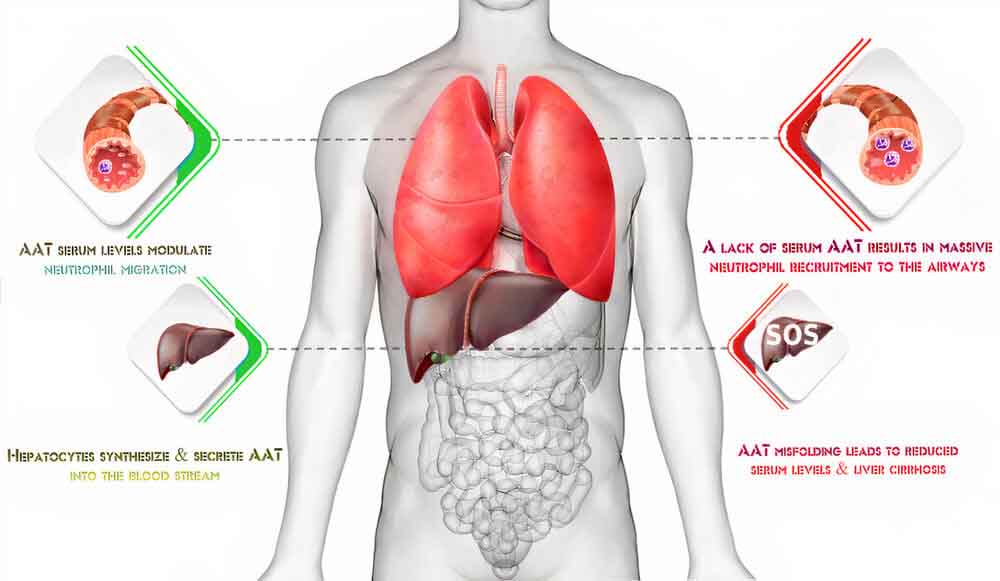
We should test all newborns with unexplained jaundice or bleeding tendency for AATD. Also, we should examine all patients with unexplained chronic obstructive lung disease and liver cirrhosis.
The doctor will ask you some questions to suspect the disease:
- Do you have a shortening of breath?
- Do you have weight loss?
- Did you have yellowish discoloration in your skin before?
- Did you have a lung infection before?
Then, your doctor will examine your chest by stethoscope for wheeze or any lung disfunction.
Then, your doctor will request the following tests:
- Blood tests: to detect the level of AAT in the blood. Normal levels range from 20 to 48 micromol/L. Also, doctors check any abnormal AAT protein in the blood due to gene mutation.
- Alpha-1-antitrypsin testing algorithm: Doctors measure the serum level of AAT by nephelometry. If the serum level of AAT is below the healthy number, we do Isoelectric focusing. Isoelectric focusing is a technique to separate proteins, depending on their isoelectric point.
- Genetic: The doctor does polymerase chain reaction (PCR) to detect the different variants of the gene (M, S, and Z). If these tests failed to check the gen variant, we could use gene sequencing of DNA to determine the gene variant.
- Spirometry: This test measures the amount of air during inspiration and forced expiration. You can take a bronchodilator to relax the airway before the test. Your doctor examines the entry of air by the spirometer.
- Measuring oxygen levels in the blood to detect the lung state is healthy or not
- Liver biopsy: to detect changes in the liver
- Imaging tests:
- Chest X-Ray: it shows basilar or apical dominant bullae of emphysema, hyperinflated lung, inflated diaphragm, and increased retrosternal airspace.
- Computed tomography (CT): CT shows emphysematous spread through the lung tissue.
- Also, we use CT and X-Ray to exclude other lung diseases.