Skip to content
Tests To Diagnose Cubital Tunnel Syndrome

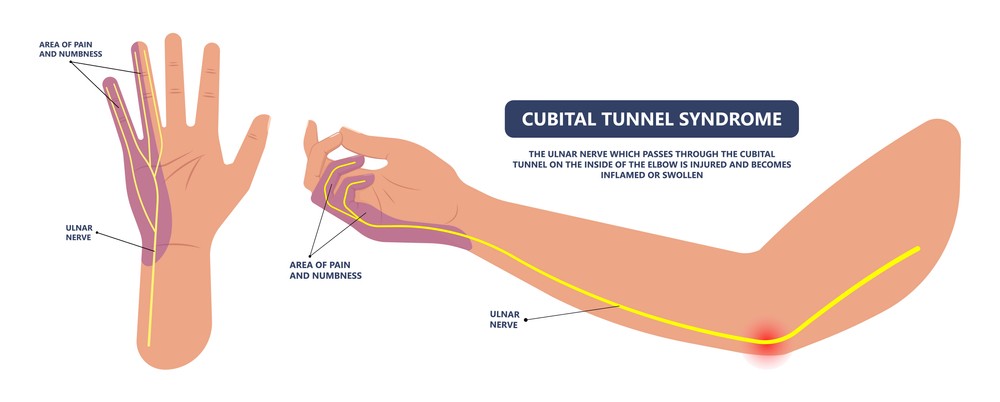
There are quite a few ways to diagnose the condition. The first is foremost to start with a good history. This gives clues if the person is suffering from any injury, dislocation, or fracture prior to experiencing pain. Moreover, clues are gathered after asking what initiated the pain and what makes it worse. More pain on the site due to movements of the elbow indicates this pathology, especially when it is moved on the medial side.
Altered sensations in the ring and little finger are usually the first symptoms reported by the patients. The doctors then conduct a few examinations to reach the diagnosis. There are two signs that are present in a patient with cubital tunnel syndrome that include:
- Froment’s Sign: Inward bent fingers being supplied by the ulnar nerve.
- Wattenberg’s Sign: Abduction of the fingers of the hand is observed.
- Elbow Flexion test: This test is performed by flexing the elbow, a feeling of numbness and tingling is felt along the entire path of the ulnar nerve.
In cases where the pain is originating without any history of trauma, ulnar nerve entrapment is usually the cause of the signs and symptoms pointing towards the syndrome.
After the history and examination are complete, there are a few important diagnostic tests performed to confirm the diagnosis and see the extent of the damage. For this purpose, a number of tests are conducted as mentioned below:
- X-ray: X-rays are usually the initial test done to see any bone deformity, osteoarthritis, spurs, or fractures.
- Blood tests: These tests are important to be conducted to rule out diabetes or any thyroid disorder.
- Ultrasound: Ultrasound helps look at the soft tissues in cases of any mass in that region causing the compression.
- MRI: If any mass appears on the ultrasound, an MRI is conducted, which helps differentiate between aneurysms, neuromas, and ganglion that could be the cause of constriction in the route of the ulnar nerve.
- Nerve Conduction test: This test is conducted to see how fast the nerve fibers are transmitting signals down their path.
- Electromyogram (EEM): This is a very important test that tests the nerve conduction to the muscles. All the muscles supplied by the ulnar nerve are therefore checked for their movements. Any kind of weakness or inability in the muscles performing their function helps diagnose ulnar nerve compression.